Tramadol and O-desmethyltramadol may be quantitated in blood, plasma or serum to monitor for abuse, confirm a diagnosis of poisoning or assist in the forensic investigation of a traffic or other criminal violation or a sudden death. Most commercial opiate immunoassay screening tests do not cross-react significantly with tramadol or its major metabolites, so chromatographic techniques must be used to detect and quantitate these substances. The concentrations of O-desmethyltramadol in the blood or plasma of a person who has taken tramadol are generally 10–20% those of the parent drug.
Saturday, July 28, 2012

Adverse effects
The most commonly reported adverse drug reactions are nausea, vomiting, sweating, itching and constipation. Drowsiness is reported, although it is less of an issue than for opioids per se. Patients prescribed tramadol for general pain relief with or without other agents have reported withdrawal symptoms including uncontrollable 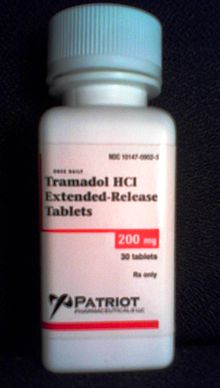 nervous tremors, muscle contracture, and 'thrashing' in bed (similar to restless leg syndrome) if weaned off the medication too quickly. Anxiety, 'buzzing', 'electrical shock' and other sensations may also be present, similar to those noted in Effexor withdrawal.Respiratory depression, a common side-effect of most opioids, is not clinically significant in normal doses. By itself, it can decrease the seizure threshold. When combined with SSRIs, tricyclic antidepressants, or in patients with epilepsy, the seizure threshold is further decreased. Seizures have been reported in humans receiving excessive single oral doses (700 mg) or large intravenous doses (300 mg). However, there have been several rare cases of people having grand-mal seizures at doses as low as 100–400 mg orally.[26][27][28] An Australian study found that of 97 confirmed new-onset seizures, eight were associated with tramadol, and that in the authors' First Seizure Clinic, "tramadol is the most frequently suspected cause of provoked seizures".[29] There appears to be growing evidence that tramadol use may have serious risks in some individuals and it is contra-indicated in patients with uncontrolled epilepsy (BNF 59). Seizures caused by tramadol are most often tonic-clonic seizures, more commonly known in the past as grand mal seizures. Also when taken with SSRIs, there is an increased risk of serotonin toxicity, which can be fatal.
nervous tremors, muscle contracture, and 'thrashing' in bed (similar to restless leg syndrome) if weaned off the medication too quickly. Anxiety, 'buzzing', 'electrical shock' and other sensations may also be present, similar to those noted in Effexor withdrawal.Respiratory depression, a common side-effect of most opioids, is not clinically significant in normal doses. By itself, it can decrease the seizure threshold. When combined with SSRIs, tricyclic antidepressants, or in patients with epilepsy, the seizure threshold is further decreased. Seizures have been reported in humans receiving excessive single oral doses (700 mg) or large intravenous doses (300 mg). However, there have been several rare cases of people having grand-mal seizures at doses as low as 100–400 mg orally.[26][27][28] An Australian study found that of 97 confirmed new-onset seizures, eight were associated with tramadol, and that in the authors' First Seizure Clinic, "tramadol is the most frequently suspected cause of provoked seizures".[29] There appears to be growing evidence that tramadol use may have serious risks in some individuals and it is contra-indicated in patients with uncontrolled epilepsy (BNF 59). Seizures caused by tramadol are most often tonic-clonic seizures, more commonly known in the past as grand mal seizures. Also when taken with SSRIs, there is an increased risk of serotonin toxicity, which can be fatal.
Fewer than 1% of users have a presumed incident seizure claim after their first tramadol prescription. Risk of seizure claim increases two- to six-fold among users adjusted for selected comorbidities and concomitant drugs. Risk of seizure is highest among those aged 25–54 years, those with more than four tramadol prescriptions, and those with a history of alcohol abuse, stroke, or head injury.[24] Dosages of warfarin may need to be reduced for anticoagulated patients to avoid bleeding complications. Constipation can be severe especially in the elderly requiring manual evacuation of the bowel.[citation needed] Furthermore, there are suggestions that chronic opioid administration may induce a state of immune tolerance,[30] although tramadol, in contrast to typical opioids may enhance immune function.[31][32][33] Some have also stressed the negative effects of opioids on cognitive functioning and personality.[34]
Availability and usage
Tramadol is classified as a central nervous system drug usually marketed as the hydrochloride salt (tramadol hydrochloride); the tartrate is seen on rare occasions, and rarely (in the US at least) tramadol is available for both injection (intravenous and/orintramuscular) and oral administration. The most well known dosing unit is the 50 mg generic tablet made by several manufacturers. It is also commonly available in conjunction with APAP (paracetamol, acetaminophen) as Ultracet, in the form of a smaller dose of 37.5 mg tramadol and 325 mg of APAP. The solutions suitable for injection are used in patient-controlled analgesia pumps under some circumstances, either as the sole agent or along with another agent such as morphine.
Tramadol comes in many forms, including:
- capsules (regular and extended release)
- tablets (regular, extended release, chewable, low-residue and/or uncoated tablets that can be taken by the sublingual and buccal routes)
- suppositories
- effervescent tablets and powders
- ampules of sterile solution for SC, IM, and IV injection
- preservative-free solutions for injection by the various spinal routes (epidural, intrathecal, caudal, and others)
- powders for compounding
- liquids both with and without alcohol for oral and sub-lingual administration, available in regular phials and bottles, dropper bottles, bottles with a pump similar to those used with liquid soap and phials with droppers built into the cap
- tablets and capsules containing (acetaminophen/APAP), aspirin and other agents.
Tramadol is regularly used in the form of an ingredient in multi-agent topical gels, creams, and solutions for nerve pain, rectal foam, concentrated retention enema, and a skin plaster (transdermal patch) quite similar to those used with lidocaine.
Tramadol has a characteristic and unpleasant taste which is mildly bitter but much less so than morphine and codeine. Oral and sublingual drops and liquid preparations come with and without added flavoring. Also, 50 mg water-soluble tramadol tablets have strawberry-flavouring, no matter which company manufacture it, to distinguish every, same-looking and same sized Mirtazapine sublingual tablets, which has orange flavouring irrespective of the manufacturer.[citation needed] This different flavouring is considered to be a standard. Its relative effectiveness via transmucosal routes (i.e. sublingual, buccal, rectal) is similar to that of codeine, and, like codeine, it is also metabolized in the liver to stronger metabolites (see below).
The maximum dosage per day is 400 mg for oral use and 600 mg for parenteral use. Certain manufacturers or formulations have lower maximum doses. For example, Ultracet (37.5 mg/325 mg tramadol/APAP tablets) is capped at 8 tablets per day (300 mg/day) due to its acetaminophen content. Ultram ER is available in 100, 200, and 300 mg/day doses and is explicitly capped at 300 mg/day as well.
Patients taking SSRIs (Prozac, Zoloft, etc.), SNRIs (Effexor, etc.), TCAs, MAOIs, or other strong opioids (oxycodone, methadone, fentanyl, morphine), as well as the elderly (> 75 years old), pediatric (< 18 years old), and those with severely reduced renal (kidney) or hepatic (liver) function should consult their doctor regarding adjusted dosing or whether to use tramadol at all.
Medical uses of tramadol
Tramadol is used similarly to codeine, to treat moderate to severe pain.[5] Pharmacologically, Tramadol is similar to levorphanol (albeit with much lower μ-agonism), both agents have SNRI activity. Dextropropoxyphene (Darvon) & M1-like molecule tapentadol (Nucynta, a new synthetic atypical opioid made to mimic the agonistic properties of tramadol's metabolite, M1(O-Desmethyltramadol)) also have similar activities. Tramadol is also molecularly similar to venlafaxine (Effexor) and has similar SNRI effects, with antinociceptive effects. It has been suggested that tramadol could be effective for alleviating symptoms of depression, anxiety, and phobias[6] because of its action on the noradrenergic and serotonergic systems, such as its "atypical" opioid activity.[7] However, health professionals have not endorsed its use for these disorders,[8][9] claiming it may be used as a unique treatment (only when other treatments failed), and must be used under the control of a psychiatrist.[10][11]
In May 2009, the United States Food and Drug Administration issued a Warning Letter to Johnson & Johnson, alleging that a promotional website commissioned by the manufacturer had "overstated the efficacy" of the drug, and "minimized the serious risks".[12]The company which produced it, the German pharmaceutical company Grünenthal GmbH, were alleged to be guilty of "minimizing" the habituating nature of the drug, although it showed little abuse liability in preliminary tests.[citation needed] The 2010 Physicians Desk Reference contains several warnings from the manufacturer, which were not present in prior years. The warnings include stronger language regarding the habituating potential of tramadol, the possibility of difficulty breathing while on the medication, a new list of more serious side effects, and a notice that tramadol is not to be used in place of opiate medications for addicts. Tramadol is also not to be used in efforts to wean addict patients from opiate drugs, nor to be used to manage long-term opiate addiction.
What is Tramadol?
Tramadol hydrochloride (trademarked as Conzip, Ryzolt, Ultracet, Ultram in the USA, Ralivia and Zytram XL in Canada) is a centrally-acting synthetic analgesic used to treat moderate to moderately-severe pain. The drug has a wide range of applications, including treatment of rheumatoid arthritis, restless legs syndrome and fibromyalgia. It was launched and marketed as Tramal by the German pharmaceutical company Grünenthal GmbH in 1977.[1][2]
Tramadol is a very weak μ-opioid receptor agonist, induces serotonin release, and inhibits the reuptake of norepinephrine.[3][4] Tramadol is converted to O-desmethyltramadol, a significantly more potent μ-opioid agonist. The opioid agonistic effect of tramadol and its major metabolite(s) is almost exclusively mediated by such μ-opioid receptors. This further distinguishes tramadol from opioids in general (including morphine), which do not possess tramadol's degree of receptor subtype selectivity and which are much stronger opiate-receptor agonists. Similarly, the habituating properties of tramadol (such as they are) are arguably mainly due to μ-opioid agonism with contributions from serotonergic and noradrenergic effects.
Subscribe to:
Comments (Atom)